This episode is brought to you by Popup Maker & WP Fusion
Boost Your Website’s Leads & Sales with Popup Maker
Get started for free or save 15% OFF Popup Maker Premium—the most trusted WordPress popup plugin to grow your email list and increase sales conversions.
Automate Your WordPress LMS & CRM with WP Fusion
Connect your website to your CRM, automate your marketing, and personalize your students’ learning journey. Save 15% OFF WP Fusion with coupon code LIFTERLMS.
In this LMScast episode, Chris Badgett takes a deep and honest look back at more than 12 years of creating LifterLMS, detailing seven big blunders that molded both the product and his evolution as an entrepreneur. He starts out by discussing content and SEO, stating that one of his first regrets was not learning how to write effectively for search engines earlier.
Even while the team regularly produced blogs, videos, and podcasts, he subsequently came to the conclusion that they might have had a greater early edge in search visibility especially in the cutthroat WordPress ecosystem, had they produced more strategic, technically optimized textual material. He then discusses supplementary aspects that are under-marketed. Although LifterLMS is well-known for its ability to create courses, he notes that many users were unaware of the full potential of the platform since significant features like memberships, social learning, and coaching tools were not adequately articulated.
He also questions the widely held belief in entrepreneurship that markets act rationally. Chris discusses how branding, emotion, perception, and “vibes” frequently influence user decisions rather than just rational comparisons. This is evident when rival WordPress tools become dominant not usually because they are objectively superior, but rather because they rose to the top of their respective categories early on and gained a great deal of reputation and trust. Design is yet another important lesson. He acknowledges that design was not given enough attention early in the company’s expansion.
Over time, he discovered that even in cases when the core product is solid, UI/UX, branding, and visual presentation have a significant impact on trust and conversion. He considers how the product and brand impression were greatly enhanced by subsequent investments in expert design teams. After that, he discusses operations, stressing the significance of recording standard operating procedures (SOPs).
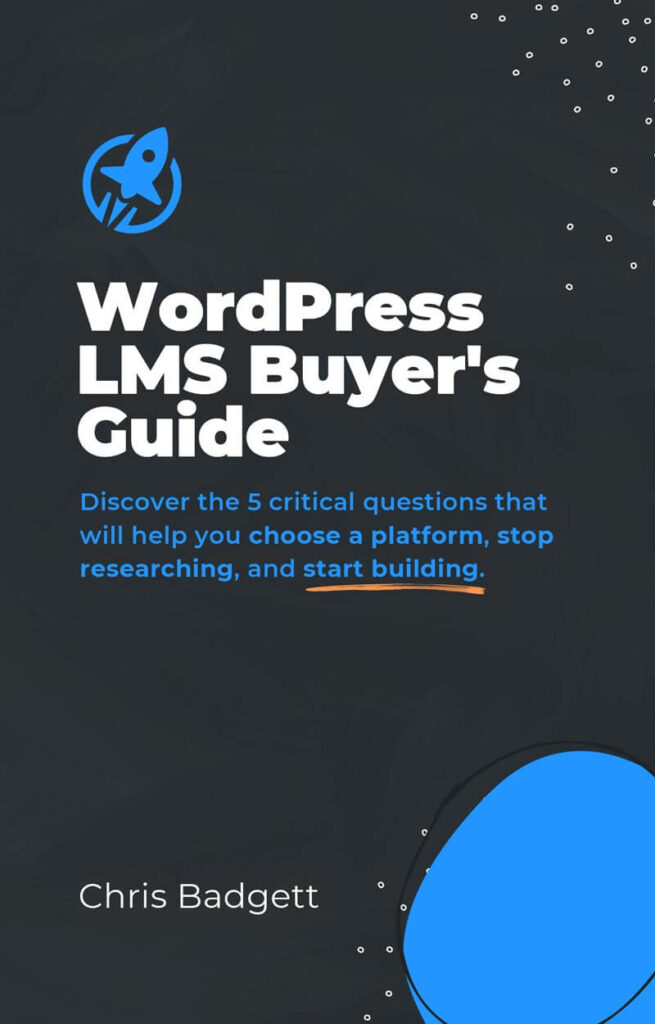
2025 WordPress LMS Buyer’s Guide
Exclusive Download! Stop wasting time and money researching online course and membership site tech.
Here’s Where To Go Next…
Get the Course Creator Starter Kit to help you (or your client) create, launch, and scale a high-value online learning website.
Also visit the creators of the LMScast podcast over at LifterLMS, the world’s leading most customizable learning management system software for WordPress. Create courses, coaching programs, online schools, and more with LifterLMS.
Browse more recent episodes of the LMScast podcast here or explore the entire back catalog since 2014.
And be sure to subscribe to get new podcast episodes delivered to your inbox every week.
Episode Transcript
Chris Badgett: You’ve come to the right place if you’re looking to create, launch, and scale a high value online training program. I’m your guide, Chris Badget. I’m the co-founder of lifter LMS, the most powerful learning management system for WordPress. State of the end, I’ve got something special for you. Enjoy the show.
Hello, and welcome back to another episode of LMS Cast. I’m Chris Badgett, and today we’re doing a solo episode about seven things I got wrong over the 12 plus years of building lifter LMS. Now, it’s important to note that I’m gonna be talking about my journey with lifter LMS, but the failures that I had, these top seven failures that I have.
Apply to any entrepreneur, but especially to education entrepreneurs. So I also wanted to note that normalizing making mistakes and failures is something I really believe in. As a parent, as a boss in personal development, all of that. So as an example on our all hands meeting, we have at Lifter LMS, there’s a section in the meeting called Failures.
And in that section anybody can add anything that they failed on since the last meeting. Because failure is just feedback. It’s essentially a learning opportunity. And if you pretend they don’t exist, then you’re really limiting your ability to grow. I wanna celebrate the failures here. Be open and honest and vulnerable and share them with you.
And if I could go back 12, 13 years, I would try to help the earlier version of myself avoid these failures. So as a brief origin story of Lifter LMS, I used to do nothing with web technology at all. I used to. Live on a glacier that you can only get to by helicopter and manage a sled dog tour business.
There’s a couple hundred dogs up there, about 30 people, and that’s what I did for almost a decade before lifter LMS. After I left Alaska I started building websites for myself, then for clients. Then launched my own online courses in the permaculture niche. Also partnering with experts. I focused my web design agency on the LMS or course creator coach Niche.
I merged my agency with another agency who had some bigger clients, and we joined forces and went even deeper into courses, coaching, marketing automation, WordPress, custom development, and through some of our clients over there, we developed. The LMS that never existed in WordPress that we really wanted, and that was launched in 2013 or 14.
And when we first launched Lifter LMS, we got 42 customers in that first week, and that was the beginning of lifter LMS. And here we are 12 years later, 12 plus years later, it’s been a very windy road. There’s been some ups, there’s been some downs. We’re gonna talk about the downs today, and I want you to learn and grow and try to avoid these mistakes in your business and your entrepreneurial venture.
So the first failure I made when looking back over the past 12, 13 years is not developing early as I could have as a SEO writer. So what do I mean by that? I have been blogging on the literal LM s website and not just me team members as well since we first launched, even before we launched. But over time, I wouldn’t say I became a decent content writer for my type of business until about five years ago, and I’m still a work in progress and improving all the time.
But what I noticed is in the software space where we exist some other. Brands who got on the content game earlier, the written content, the blogging game earlier with strong SEO skills really got a huge advantage in the early days. And it’s not that I wasn’t blogging or writing, but I just didn’t have the deep technical SEO skills as well as I was a decent rider, but I really hadn’t mastered the skill of.
Technical writing and storytelling and so on that to the level that I now possess. And I could have developed that sooner and gotten some of that SEO advantage. And it’s not that I didn’t do anything else. I also poured a lot into YouTube. Even this podcast you’re listening to is older than lifter, LMS plugin.
We launched this back in this podcast back in 2013. So I’ve been creating audio, video, and text content for a very long time. But if I could go back in time, I would’ve put more focus on the early text and blogging content, and particularly for the education entrepreneurs out there. One of the challenges we have is that a lot of our content is behind.
An enrollment or a paywall. So we spend all this time creating video content, audio content reports, text content, but we’re not really putting as much effort as we could in that SEO driven blog content and pages on our site. So the lesson is to diversify your content types early and make sure you have a lot of great free written SEO optimized content, which also becomes extremely important.
For AI to train the large language models on so that you have some freely available text-based content for the artificial intelligence to ingest. The second big failure I had at lifter LMS was under marketing secondary benefits. So what do I mean by that? The primary benefit of lifter LMS is related to the courses feature.
So you can create, launch and scale high value online courses with lifter LMS. The course creation is like the main thing that makes lifter LMS special and unique. Chris, myself is an online course expert, excuse me. And but. Because Lifter is a platform, it’s a learning management system.
There’s so much it does in addition to courses. A perfect example where we under marketed is the membership features of Lifter LMS. So Lifter, LMS has been a membership plugin since the very first version, but a lot of people don’t even realize that they think they need Lifter. And another membership plugin, which it does work with other membership plugins like paid memberships Pro.
Lifter’s own native membership features are very powerful for creating course bundles, locking down other parts of the website and so on. But we under marketed that. Another example would be the social learning add-on that lifter makes. It basically allows you to create an online community website similar to having a private Facebook group, but on your WordPress LMS website that you own and control.
When I look at something like Buddy Boss, which is an online community building WordPress plugin, which also integrates with Lifter Al Mess, by the way, which we’re grateful for. Buddy Boss did an exceptional job marketing the online community system to the WordPress website. And of course they did ’cause that’s their main feature.
But for us at Lifter, that’s a secondary feature. Social learning solution that we offer. So we under marketed that. And there’s many more inside of Lifter as a complete system, a learning management system. There’s so much that it does that we’re not telling the full story and we hear this we, know we’ve made this failure.
When I hear from the market, it’ll say something like oh, wow. I’ve been using your software for years and I didn’t even realize. You guys had memberships or that I could build an online community here, or I could do my coaching business, or you had this email system and marketing automation system built directly inside lifter LMS.
So that kind of thing is what I’m talking about. So it’s important to know the main thing, the one thing, your primary benefit, but also be sure to market your sub benefits and other aspects. I would use the rule of thirds here, by the way. So think about your primary benefit and then what are the three sub benefits below that, and then go out three more.
So like primary benefits, number one, then the main three, then the main nine, and that’ll keep you busy for a while. So focus on that in terms of marketing and. Content and social media and selling and landing pages and design for all those things. The next big mistake that we made was thinking that the market is rational.
So what do I mean by that? The market is, and I think there’s even a book by this title called Predictably Irrational. So I used to think that the best product would become the most popular product, and that’s not the case. It’s almost never the case. One might argue that in very few cases, is that actually true?
It could be. There’s other factors like cost and stuff like that. But what I mean here is. In the market. So what do I mean by the market? The market is your niche. It’s the people, it’s your target market. It’s the prospects that are a good fit for your service or product. Those people are not rational.
They are irrational. And by the way, I say that with love because when I’m a consumer, I can also be irrational. So a market is irrational and is driven by. Things like emotion vibes cognitive biases, misinformation, group think social pressure, all kinds of things influence a, market and makes them not critical thinking, looking at base reality with a complete logical and objective perspective.
So how has this hurt us at lifter LMS? I realized early that we really, this software does a lot. We need to tell the story of it. It has a lot of features. We need to basically be sure the market understands all the features that we have and those benefits. So we spent a lot of time in documentation, YouTube tutorials informational pages, blog content on our site, but then.
What I noticed is the I’d see in the market when, like on social media, like on Reddit or in a Facebook group or in Twitter somewhere, a lot of the stuff people say when they compare our solution to other solutions were factually inaccurate. Lacked complete information, even lies and misinformation.
I was like, why is this happening? I’m like, oh, okay. Yeah, the market’s just being irrational. And a lot of people are just going off vibes and jumping on the bandwagon of this or that. If you look at the WordPress ecosystem WordPress has this challenge called the king maker problem. So what do I mean by the king maker Pro problem?
The king maker problem is where an early winner kind of dominates for a long term. So even if they’re not actually. The best or based on pure value, features, benefits, all that. Like they have an unnaturally king size portion of the pie that’s irrational if you were to just compare apples to apples across the various solutions.
So in WordPress, as an example, the divvy theme and page builder, if we look at WordPress page builders, now, a lot has changed with full site editing and Gutenberg and all of that. But at one point, divvy really nailed the WordPress premium theme market. They got early traction. Elegant themes used to have a lot of themes.
Speaker 4: This episode of LMS Cast is brought to you by Popup Maker Lewis, powerful and trusted popup solution for WordPress. Whether you’re selling online courses or building a membership site, popup maker helps you grow your email list, boost conversions, and engage your visitors with highly targeted.
Customizable popups. You can create smart popups for things like Lifter LMS or WooCommerce Cart Abandonment Recovery Sales Course Engagement, activation, targeted offers based on exactly what your students are doing. Inside Lifter LMSI personally use Popup Maker on all of our websites at Lifter lms. For lead magnet opt-ins, card abandonment, upsells, downsells, and guiding users to the right next step.
Popup maker is essential for growing my email list and making more money through my website. Are you ready to take your website to the next level and on over to wp popup maker.com/lmscast to save. 15% off on your order. The discount automatically applies when you visit through that link. Popup Maker also has a free version, so you can start with that too.
So go to wp popup maker.com/lmscast now to say 15% or sign up for the free plan and start getting more leads, sales and student engagement today. Now back to the show.
Speaker: Then divvy really took off. They focused on divvy. They built a page builder around Divvy, and they got huge. At one time, the Elegant Themes website was one of the most trafficked websites in the world, so they really got that king maker crown. And over time, other page builders came like Beaver Builder or Elementor, and many more.
A lot of times Divvy has always had the biggest market share, I believe. And is that rational, is divvy better than Elementor or Beaver Builder or some of these other ones? This is the king maker issue and I’m a fan of Divvy. I’m not a, an expert at page builders. But this is what I’m talking about and it, you has this tribal mentality.
Like I was a, I used Beaver Builder for a long time. I really loved it. And I see folks in elementary using elementary really loving it, see people using divvy, really loving it, and they’ve been using it forever. The same thing happens in the WordPress form space. If we looked at the early winter there, that was a company called Gravity Forms.
I’ve been a Gravity Forms customer for probably about 14 years, something like that, 15 years. I use it on the Lifter LMS website. Lifter integrates with it. It’s an awesome, huge solution with a awesome ecosystem. Tools like Gravity Kit or out there that work with Gravity Forms, and some of those have lifter integration, which is awesome.
And. But there’s other forms. There’s like a lot of form plugin solutions in WordPress and a new one, like a newer one. It’s not new anymore, but WS form by Mark West Card is an awesome form solution, but I know it’s hard for Mark West card of WS form to compete with gravity forms simply because of that kingmaker issue.
Some of the, there’s stuff that WS forms does that is so awesome. Gravity formed, can’t do, doesn’t do, and so on. They’re both great solutions, but this is what I’m talking about. The market is not rational and sometimes that early dominant player their snowball just gets bigger and bigger, and it takes on its own life and vibes in terms of popularity that’s not really based on rational analysis.
In terms of as a creator it’s important to build things like audience trust and a brand that basically play the irrational game, but do it with ethics. So what I mean by that is build a strong brand. ’cause people want to do business with people that they know and trust. One of my big things, particularly in tech that I find.
Amusing just from or more sad is actually the word. If I go to a start a software company’s website and I go to the about page and I see no human faces, I see such a lost opportunity. ’cause people want to connect, they want to do business with real people. They want to take a quick peek at the people behind the company and so on.
While building a personal brand. May feel like a sideshow to your actual product. It’s a big part of just building the vibes that the market actually responds to in addition to the logical analysis of your features and benefits. So the next big fail that we had at Lifter LMS was not elevating design to the executive level sooner.
So what do I mean by design? Design is a lot of things. It is for an online business, it is graphic design. It’s website design. It’s user interface design. It’s user experience design. It is if you’re doing courses, there’s instructional design. There’s all these different flavors of design that are super important, and let me back up and say that any online business, I divide into seven categories, and design is one of those, but I’ll just list them off here.
One is product, one is engineering. One is marketing. One is sales, one is customer success or support. One is operations. And then the final one is the CEO hat and design is of course in there too. So all of these areas need to have a baseline level of proficiency for a business to do well, and design often gets ignored for too long, or overemphasized in the beginning.
So in my case, we had, we were underpowered on the design front in the early days. So I heard it on a podcast, I can’t remember where, but I’d cite the source if I remembered. But it was something like, investors looking to invest in startups. They look at three, they want to see three main characters in the founding team, the hipster, the hacker, and the hustler.
The hacker is the engineer. It’s the coder. It’s the person doing the tech, the hustler. That’s a person like me, who is the visionary, who gets the people together, who goes out and does the marketing, sales, what we call hand to hand combat to get your early first customers. But then there’s the hipster.
The hipster comes in and sprinkles all kinds of design. Goodness on top of what the hustler and the hacker are doing. So to give a specific example, the hacker or the engineer is building interfaces for lifter LMS as an example, like interfaces for the software. The designer comes on top as a UI or user interface designer and makes them pretty standardized, intuitive.
User experience aspect of design comes in and knows exactly where to put tool tips and helpful pointers or informational text to make an interface clear, and that’s just one little spot. The designer might come in and help the hustler with a slide presentation or to make the product graphics look better.
Or to make the website key sales pages, landing pages and homepage look 10 times better. That’s what the designer does. And we’ve been lucky at lifter LMS to get some quality design leaderships at several points in the business, but I did not do it soon enough. And if you happen to be early in starting your business, one, I’d recommend don’t do it alone.
See if you can assemble the team of the hipster, the hacker, and the hustler, which one are you most like? And then find the other two. Not being alone is key. Having a partnership is great, but having the hipster hacker hustler trifecta is an unstoppable unbeatable, beautiful team. So that’s what design is like.
And to give you some examples of. Where design came in and really helped lifter LMS and it was way too little, too late kind of thing. In a perfect world, I’m very grateful for everything that we did, but I made, I prioritize those design needs too late. Okay? The first one was about three years into the business.
When we actually got lucky. We used a service called 99 Designs to do our logo. Our colors, our typo typography was known as a brand kit, and we should have done that way earlier than with the scrappy design we had. I definitely admit if you’re just launching a product or business, don’t overfocus on design.
Don’t spend a lot of money on a logo or anything. You can just go minimum viable product and find your product market fit. Once you have it, assuming you succeed and you have some traction, invest in that design for the brand kit early. We got lucky with 99 designs and paid about 300 and got basically the brand kit that we still use today for almost a decade, which is awesome.
Now the next big move we did was around I think it was 2020 or so. We hired web dev studios to come in and help do a redesign of our whole website, help with the design of the lifter LMS screens, how our launchpad theme, or I’m sorry, our Sky Pilot theme would look. Web Dev studios is awesome. We’ve done some webinars and they’ve been on the podcast.
They also have a product called Theme Switcher Pro. I’d encourage you to check that out. Which allows you to switch. Your theme, but only on certain parts of your website. But anyways, the design team at web dev studios did an incredible job building designs that we could then implement. So that was a huge win.
And that wasn’t cheap either. We invested many tens of thousands of dollars in that design but it really paid off. It wasn’t just like the website. It was also software and interface and all these things. So that’s web dev studios design, overhaul of lifter LMS. And then the next one is when Kim Coleman joined the leadership team as a co-owner of Lifter LMS with Jason Coleman.
Speaker 5: This episode of LMS Cast is brought to you by WP Fusion, the powerful WordPress software that connects your website to your CRM and marketing automation platform. Whether that’s HubSpot, Salesforce active campaign. Go high level and many, more. If you’re selling online courses, memberships, coaching digital products, and more.
WP Fusion. Turns your WordPress website into a smarter, more personalized and more automated online business with deep integration into Lifter LMS WooCommerce, the popular form plugins, and many more top WordPress tools. WP Fusion lets you automatically create and tag contacts, unlock course and membership access rack student progress, recover abandoned carts and trigger powerful automations based on what your users are actually doing.
On your LMS website, we use WP Fusion ourselves on our Lifter LMS website, which is powered by WooCommerce. For selling software subscriptions, but we also use WP Fusion on the Lifter LMS Academy. Where we are selling access to courses and memberships, powered of course by lifter LMS WP Fusion connects our websites and CRM seamlessly together so that we can create a better customer journey, deliver the right offers, and automate follow up.
Based on user behavior. If you wanna sell more, personalize a learning experience, and build a more connected automated online business, check out WP Fusion today. Go to wp fusion.com and use the coupon code lifter LMS to save 15%. Now back to the show.
Kim has a really unique ability. She’s an amazing designer, but she’s also a fantastic entrepreneur, developer, marketer, and so on. She’s super strong on design, so she was able to, in a major way, help implement the designs from web dev studios to create reusable templates for all kinds of things like YouTube thumbnails, webinar slides, product shots, and everything inside Canva so that our non-designers, including myself, can implement great designs using templates in Canva.
Kim did so much to and, also in the interface and the UI and just her design sense was so strong. It is just just a wonderful thing to have in the leadership team of lifter LMS. But, so if I could rewind the clock and go back to the early version myself, I would have prioritized that design.
Leadership sooner. And that also feeds into the last failure I mentioned where the market is not rational. It took me a while to realize that having good design can help with your vibes. It’s not rational, but it’s true that sometimes people buy from. If they’re exploring product A, B, and C, they’re gonna go with a ’cause that website has the best catchy design.
Apple as an example, has great design. People talk about it all the time. So design is a huge part of the irrational mind buying on vibes. So the fifth failure that we made at lifter LMS in 12 years. Was not documenting standard operating procedures or what I also call business playbooks early.
And these are standard operates. Standard operating procedures are like having a baby. There’s never really a convenient time to make them, but you should, so if you’re new to SOPs or standard Operating Procedures playbooks, it’s essentially documenting your systems and processes so that it’s easier to delegate and make your brain hurt less when you’re doing a task.
For example, publishing a lifter LMS podcast episode has 40 steps. So Nadia on the team will publish that and she’ll follow the steps. If she’s away and I’m publishing it or somebody else is publishing it, I’m gonna follow those steps. Even though I’ve done it before, I can never remember. And it takes such a mental tax to have to try to recall the 40 steps without looking at the documented steps that I wrote.
The other thing is getting your team to contribute to the standard operating procedures is. Really powerful. We actually use lifter LMS on a site, not our main site that’s public, but it has our private site on top of it so the public on the internet can never get inside of the site and see our standard operating procedures.
But we use lifter LMS and courses and lessons to organize and catalog and index all of our standard operating procedures broken down by department. Like sales as an example, or product as an example. When you’re, when it’s just you, if you’re a solopreneur and it’s all in your head and you’re never delegating anything, fine, you don’t need ’em.
But as soon as you need somebody else to do something for you, I’d recommend slowing down and documenting your processes, whether for a team member, a future team member, a contractor you’re gonna hire, or even just for yourself to make your brain hurt less. If you ever have, like when I do I do like this biweekly payroll, cashflow accounting, invoices, money management thing for the business, right?
Every two weeks, it’s 57 steps every single time. I’ve done it many times, every time I pull out the list and I just start working through it. If I didn’t have that playbook, my brain would hurt trying to remember everything that I have to get done to execute that process. If I had done this earlier, it would’ve helped my brain hurt less for some of the complicated things I would do, like product launches as an example, like we have our product launch process documented.
If I had done this earlier, it would’ve been easier to delegate. There’s a great book by a guy named Sam Carpenter called Work The System, which I, read that book man 15 years ago and it really sold me on the power of SOPs and playbooks. I recommend you check that out if you haven’t listened to that.
It also helps your team member do better. It also helps you delegate things better. You can delegate if some, you have more options of who you can delegate to if a process is really dialed in and clearly laid out. Whereas if you don’t do that, if you try to delegate something, you’re gonna need somebody who’s more like you, who’s just gonna figure it out and it’s gonna be really inefficient time-wise and so on.
So document how you do what you do. And if you use the framework I gave you earlier about the seven parts of a business, each one of those has processes. Design has processes, operations, like I mentioned, payroll has processes sales, how we do product launches, marketing. These all have processes. So document those.
Check out Lifter, lms, private site if you want to put all your playbooks inside of an LMS. The next thing that was a big fail for me in building lifter LMS over the past 12 years is stressing too much, which some find funny hearing that coming from me because I seem like a chill, laid back, slow talking person.
But that is just me on the outside and it’s not a front, it’s just who I am. But I do get stressed. I take things seriously. I take a lot of responsibility. There are families including my own, that depend on me for food on the table or depend on the business for food on the table. There’s all kinds of relationships to maintain across team members, customers, users, community industry, partners all kinds of things.
There’s changes in the macro economy, the geopolitical situation things happen. And that affect the business both for good and for bad. And we all would like to have less stress. But what I find is there’s this weird thing with entrepreneurs. And I, want to hear you or find a way to reach out to me if you’re listening to this and you agree with what I mean, by the way, I don’t hear that much from the podcast listeners.
You folks are always like listening in your earbuds while you’re doing the dishes or exercising or in the car, whatever, and commuting. But I’d love to hear what you like about this show. But anyways, here’s the counterintuitive insight about entrepreneurs. I look around YouTube as an example, and I see all this content about like motivation and how to find your motivation and all this stuff, and I’m, I’ve never needed that my entire life.
Like I am born with the batteries included and I have the opposite problem of motivation. I have too much motivation, which creates stress ’cause I can’t, there’s so much I want to do and can’t get done. BA based on constraints, whether that’s cash or time or capacity or skills, that’s stressful, right?
So I think the counterintuitive thing and hit me up if you agree, is I look out the world and sometimes I see a lack of motivation, but when I look inside myself, I see too much motivation, which causes a lot of stress. So for me, it’s actually counterproductive. To try to get more motivated. ’cause I don’t need more.
I actually need less, which is weird to say. Luckily for me I’ve had some things that help me manage the stress. The big ones are, and I’m just speaking for me personally. The big ones are rural living. So a slower pace lifestyle in the country. The second one is nature connection. I do spend a lot of time outside.
And the third one is exercise. If you know me I’m an ultra runner. I can run far along and I didn’t always used to be this way. I’ve always tried to keep moving and stuff like that, but once I really found Ultra, I’m like, oh yeah, this is what Dan Martel means by train the body to tame the mind.
So when I get to the. Out there in the distance far, not just like on a big thing, but even just even today. Today I’m gonna go run eight and a half miles after I get off this podcast later in the day. And I’ll feel way better after that. But anyways, going back to the earlier days, stressing too much particularly in the early days, I did it the way where.
I didn’t try to start I didn’t try to start it as a, my business as a side job. I did the burn the boats thing, which just means for me, I left Alaska. I stopped what I had been doing for almost a decade. It’s 100% on me to figure everything out while I also have a young family. So that’s pretty stressful.
When you cut off your, dependable income. Do that. And it was really rough in the beginning, particularly going from that zero to like sustainable level. So there’s just so much stress in that period. And part of it, I do believe in the early days of a startup of any kind, you do need to grind. You do need to have some late nights and put it all out there, leave it all out in the field.
But as much as you can build in stress reduction, things that work for you, whether that’s. Massage walks, hanging out with friends, doing something with your partner. Nature connection, some kind of sport. Maybe it’s a float tank, a sensory deprivation chamber, whatever it is for you. Try not to stress too much because unfortunately I see so much burnout and so many people that quit.
Or flame out that shouldn’t in, in the space of entrepreneurship and stress is really the killer. It’s the, it got outta control and for whatever reason mostly luck. I would say just with how I’m wired and what I’m into, I was able to tame the stress to a manageable level through the movement, the exercise, the nature connection, and so on.
So find what that is for you. Find it as soon as possible, and just remember that entrepreneurship is a personal development program. So the biggest personal development thing you can do is figure out how to be an entrepreneur without burning out, blowing up, or getting super stressed out. Or if you already have.
To move forward in a better way to learn to transcend and learn how to manage stress in a much healthier way. The last failure I had with lifter LMS over the past 13 years is two things, hiring too fast or hiring too late. So both extremes hurt. Hiring too fast is an example. As an overwhelmed, stressed out entrepreneur, you want to delegate, but everybody, all the advice is like, oh you gotta, delegate, you gotta build your systems and delegate.
I’m even telling you that here, but before you can afford that you, can’t do that. Here’s what I mean by that. In the early days of Lifter LMS, we had two support team members. In addition to the founding team, lifter, LMS is way, bigger now over a decade later. And we still have two support team members in addition to the rest of the team.
And that’s good. But those early two I, we hired way too early. And it could have just been one is what I’m saying. There’s. Hiring is really hard. It’s it’s extremely hard. I could do, I should do a whole episode. I’m taking a note to do one on hiring ’cause I’m actually pretty decent at it and I’ve learned a lot over the years.
So I’ll look forward to sharing that with you in a different episode. But the other thing is just hiring too late. I mentioned the design situation, figuring out how to get design hired into whether it’s a contract project. A team member, a new business partner, doing that sooner would’ve been way better for the business.
So that was an example of a too late situation. So one of the ways to think about it is to hire at an inflection point, not based on emotion. ’cause sometimes we’re just like, oh my gosh, I’m so stressed out. I’m so burnt out. I just need another human to dump all this work onto or whatever. That’s not a healthy way to think about it.
You want to think about it as an inflection point. So an easy way to think about that, like in software as an example, is when you’re doing support. You get like a certain number of tech support tickets or emails a day. You can look at that oh a support team’s capacity is about X tickets per day on average.
Once you’re consistently past what your team can do on average, that’s just an inflection point where you either have to hire or some other members of your team or maybe even you need to also help to keep up with the demand in that need. So try not to hire based on emotion or desperation or frustration.
Hiring should be more mechanical, methodical. If you look, we have a free course on the academy about end of year planning and 10 year plans, five year plans and all this stuff. Go check that out. But one of the ways I like to think about hiring at the right time is to build your dream org chart like how you want it to look.
For example, if Lifter LMS were to double the revenue of where we’re at right now. I already know that what the org chart would look like and what roles to hire, and I know when at which revenue milestone we could afford to hire, which role next. Now, that might change. Plans can change, but I already have that figured out, so it won’t be an emotional thing for me.
I won’t know if we have the budget or not for it. It’s already planned out. And the other thing I’ll just add with hiring now is. If you look at artificial intelligence, there’s a lot that AI can do to increase existing team capacity, including yourself. And there’s just more AI can do, even ag genetically as a higher of sorts.
So you may hire AI in some cases. And that’s one of those areas I’d look out for is. As artificial intelligence moves from the chat interface to agentic to agents you want to think about how the agents can fit into your org chart or augment your existing human team members in the org chart because with the pace of change with ai, you really.
This whole problem of hiring too fast or too late is gonna become even more and more of a problem. So by hiring too fast, what I mean is bring in an AI sales, outbound sales rep that’s gonna do all this emailing and calling for you, but you haven’t even figured out what your selling, how you sell, what your sales motion or sales conversations look like to train the agent.
So you’re just, you’re hiring way too fast and you’re just gonna cause problems or. There’s a ton of stuff you can do with AI for graphic design as an example. There’s people that are doing things with Nano Banana, which is a AI graphics tool. And other tools too. I’ve done some great designs with chat GPT and Canvas AI tools.
But if you find all that stuff too late you might be, you just might be underdoing your design capability. ’cause you, tell yourself the story. I can’t afford to hire a human at x dollars per year to do design. But you could actually get started with AI like right now. So a couple of themes from these mistakes or failures I’ve made.
There’s imbalance whether that’s content or. Marketing or team or mindset. So it’s all about balance and we’re all unique individuals, unique snowflakes, if you will. We have our strengths and weaknesses. We have these different aspects of our business that are either doing great, average or below average.
But when there’s imbalance, that’s where a lot of the biggest failures come from. So I like to think of balance in this way. You don’t have to bring everything to exceptional, but everything does have a baseline. And then there’s gonna be a couple things you do really well. It might be product, it could be operations, it could be the tech side.
But you definitely need a baseline across those seven parts of the business as well as an education entrepreneur. The five hats that we talk about all the time on this podcast. I would just encourage you to become more well-rounded and first of all, don’t be too hard on yourself. Like to me, even just telling you these stories, there’s a lot of pain When I look back at all that stress and struggle and bad timing or a decision we, I made that was suboptimal, but hey, this is how we learn and it’s okay to be an imperfect human.
That’s why. I like to say that entrepreneurship is a personal development program. You just gotta keep going and, learn from your mistakes. Be honest about them. Pretend they don’t pretend they don’t exist and work with them. Examine them. Look for patterns. Try to improve. And yeah. I want to thank you for listening to this episode.
I’d love to hear from you. Which one of the lifter LMS fails over the past decade plus resonated with you the most? And yeah. Just send me a hello. Let me know that you listened to this episode and you appreciated it, and I hope you have a great rest of your day. Take care.
And that’s a wrap for this episode of LMS Cast. Did you enjoy that episode? Tell your friends and be sure to subscribe so you don’t miss the next episode. And I’ve got a gift for you over@lifterlms.com slash gift. Go to lifter lms.com/gift. Keep learning. Keep taking action, and I’ll see you. In the next episode.
2025 WordPress LMS Buyer’s Guide
Exclusive Download! Stop wasting time and money researching online course and membership site tech.