This episode is brought to you by Popup Maker
Boost Your Website’s Leads & Sales with Popup Maker
Get started for free or save 15% OFF Popup Maker Premium—the most trusted WordPress popup plugin to grow your email list and increase sales conversions.
Chris Badgett explains the main distinctions between cohort-based and self-paced online courses in this LMScast episode, assisting course designers in selecting the approach that best suits their objectives.
According to him, self-paced courses are very scalable and manageable since they let students learn on their own, at their own pace, and at any time. These courses may produce everlasting revenue with minimal expense, and they are particularly effective for information-rich content and big, diversified audiences. The drawback of self-paced courses is that they frequently have lower completion rates, worse responsibility, less community involvement, and lower perceived value, which typically translates into cheaper costs and fewer student changes.
Chris compares this to cohort-based courses, in which students progress through the course on a same schedule. Better learning results, more engagement, a deeper sense of community, and inherent accountability are all produced by this system. Cohorts frequently feature peer interaction, group coaching, and live training, which greatly raises the perceived value and enables producers to charge higher costs.
2025 WordPress LMS Buyer’s Guide
Exclusive Download! Stop wasting time and money researching online course and membership site tech.
Here’s Where To Go Next…
Get the Course Creator Starter Kit to help you (or your client) create, launch, and scale a high-value online learning website.
Also visit the creators of the LMScast podcast over at LifterLMS, the world’s leading most customizable learning management system software for WordPress. Create courses, coaching programs, online schools, and more with LifterLMS.
Browse more recent episodes of the LMScast podcast here or explore the entire back catalog since 2014.
And be sure to subscribe to get new podcast episodes delivered to your inbox every week.
Episode Transcript
Chris Badgett: You’ve come to the right place if you’re looking to create, launch, and scale a high value online training program. I’m your guide, Chris Badget. I’m the co-founder of LifterLMS, the most powerful learning management system for WordPress. State of the end, I’ve got something special for you. Enjoy the show.
Hello, and welcome back to another episode of LMS Cast. I’m Chris Badgett doing a solo episode here, and today we’re gonna get into cohort based online courses versus self-paced online courses. How to decide which one is the right one for you. I’ve got a surprise for you in this episode. There is a hybrid version, which we’ll get into too, which I’m a big fan o of.
First, let’s start with a self-based course. Like what does that mean? So, a self-paced course is like the courses that you see on websites like you did Me or Masterclass. They often contain a series of valuable. Video lessons, maybe some quizzes, maybe some worksheets, but it’s self-paced. There’s really, uh, not much teacher interaction, probably none at all.
This is why you have some of the best instructors or subject matter experts in the world on a platform like masterclass. They create a wonderful course with awesome ideas and content and stories. But you can’t interact with them at all. And that’s why Masterclass costs $20 a month, basically. Similar, same is similar with Udemi.
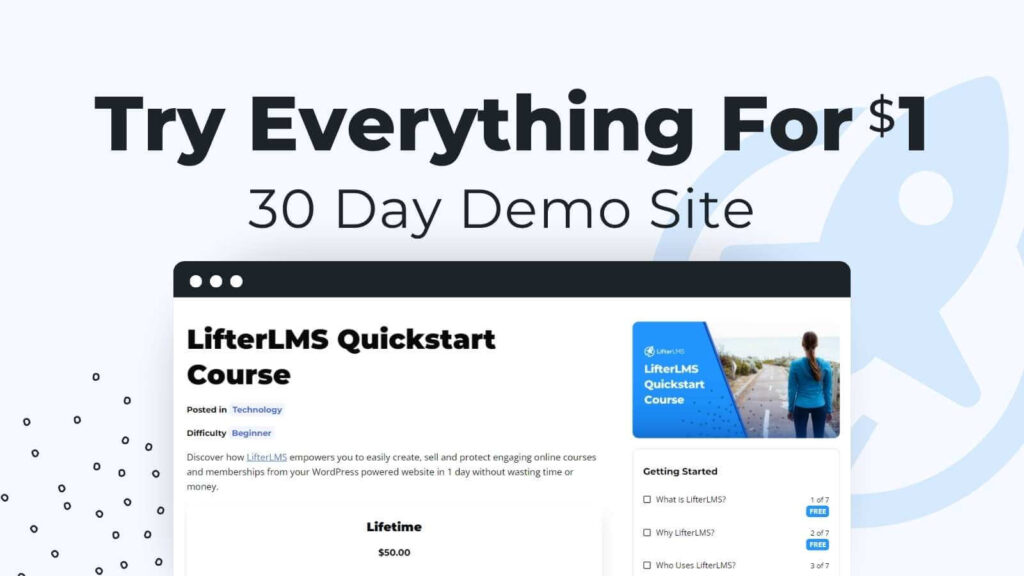
It’s mostly just self-paced. Online courses and self-paced online courses are great. For example, we have a self-paced online course at LifterLMS called the LifterLMS Quickstart course. It’s a self-paced course that essentially. It teaches you the 5% of the most essential features of LifterLMS, so that you can create and launch an online course website and start getting sales, which show you all the critical steps in under 40 minutes of training.
That’s a very powerful, popular free, self-paced online course that we make at LifterLMS. So what is a cohort based online course? A cohort based online course is where a group of people come into a course and they kind of go through it together at the same time. So if you think back to the offline world, so when you go to school, you’re the class of whatever year you’re kind of with a cohort of freshmen, sophomores, juniors, seniors, and so on.
You move as a cohort through the system. So that’s what a cohort based online course is. So that’s how they’re different. And a cohort has a lot of magic that comes with it, but it also comes with some trade-offs and by magic that comes with it. What I mean is it’s a very different thing to be an individual like by yourself taking a self-paced.
Self-paced online course learning about a subject versus kind of joining a group of people or a cohort that are going through a training at the same time. So they’re, they’re very different and they have their pros and cons, uh, which we’ll jump into. So a self-paced online course can be great. I’m gonna go over the benefits of those.
For one, they’re extremely scalable, so you could. Put a self-paced online course up on your website and it get, if it gets very popular you literally have no work to do primarily except for to keep the website online. And you could have 10 or 10,000 or 300,000 people in the same self-paced online course moving through it.
And that’s great. So it’s like extremely scalable and can create evergreen revenue. Now if you do do self-paced online courses, which a lot of people do I do recommend, you know, revisiting it every couple of years, maybe making it a little better, making improvements based on what you’ve learned and user feedback and things like that.
But the nothing beats the scalability and the evergreen, uh, revenue nature of a self-paced online course. The other benefit is it’s super flexible. There are benefits in a cohort based online course of having a community and, and group of people. But that also creates a lot of, you know, kind of social pressure.
It can where okay, the student’s gonna be more involved with the instructors or the coaches. So there’s a social demand, uh, if you’re going through it with a community or you have a community aspect to your site. That’s set up so that the cohort kind of sticks together. That can be a lot of pressure.
So like a self-paced online course. There’s literally no social pressure. Like here it is. This is an awesome course. Uh, it’s designed to get you the result that you’re looking for. Good luck. Do it at your own time, at your own pace, whenever you want. So on. So that kind of autonomy, that learner, flexible learner autonomy is a, a big benefit to a self-paced online course.
Uh, in terms of the course creator, there’s a much lower overhead to doing a self-paced online course. You don’t have the pressure of a live audience if you’re actually delivering the content live or doing. Like a cohort based group coaching model that kind of bolts on to your course and so on. So there’s just, it’s sort of like you build it once you set it up, you launch it you do the marketing, you get students and you’re good.
It’s just self-paced and it’s just more on autopilot with a lot less management. Overhead sitting on top of that. So where self-paced online courses really shine is. For information heavy courses, so similar to how in traditional school there are only so many hours in the day and school weeks in the year, there’s only so much information that you can put in there.
But a self paste online course could literally have tons of information and maybe you have somebody who’s gonna move through it really fast, or you have somebody who’s gonna take a year to work through the material. So you, you have that that ability, if it’s self-paced, that people can pick and choose, set it around their schedule, their availability, their speed, they like to learn and implement and so on.
If you have an information heavy online course. A self-paced online course can be fantastic for that. And also, self-paced courses really fit well when you’re doing. A large audience, right? You can have large cohorts but if you have a really big audience, a self-based online course is gonna be easier to manage.
And particularly if your audience is very diverse and you know, there’s more variability in what we would call the student avatar or customer avatar. A self-paced online course can be good for large audiences. Come with people coming from varying backgrounds where the cohort just wouldn’t be as effective as a tightly scoped, you know, smaller group with very similar people in it and things like that.
So the cons of a self-paced online course, is the dirty little secret in our industry is that they do have lower completion rates and lower. Results or students getting the transformation that the course offer promises.
The reason for that is when somebody is like, kind of alone in a self-paced online course with very little support around them or community, it is much easier for somebody to get distracted, not finish, lose motivation and so on.
So that’s a drawback too. The self-paced online course, you know, ’cause there’s really limited accountability. You don’t have that peer accountability or that instructor, uh, accountability. And it’s much harder to build a community around a self-paced online course. For example, you could have a self-paced online course and then put a social learning community on your website or on social media, like in a Facebook group or a Slack group.
But for a self-paced online course. When people are coming in at all different times from all different backgrounds. It’s much harder for them to connect with each other. The example I like to give there is if you’ve ever come into a community. It feels like, the people in the community have been like doing this thing for like many, many years, and they all know each other.
It can feel really intimidating and so on. And they’re just at a different level. ’cause they’ve already. You know, they’re further along in the training or implementation and so on. So community building with a self-paced evergreen online course is much harder. Self-paced. Online courses also have lower perceived value because you don’t have that benefit of the cohort and.
A group coaching model that’s designed or even one-on-one coaching that goes with it. Where it’s designed to work with a cohort of people. Who are all progressing through something at the same time. Because of that, a self-paced online course does not, cannot command as high of a price point as a well orchestrated cohort based course.
So switching gears over to cohort based online courses some of the benefits is they do have higher completion rates and student results and transformations simply because the cohort supports on top of like the training content. A self-paced online course is mostly the training content, uh, but a cohort.
Just adds a, a whole other value layer that that helps, you know, it helps you command higher prices and it, but more importantly. It helps support students. It’s a support mechanism. A cohort is, part of the offer, if you will. There’s a saying in the online business world that I’ve experienced myself on.
The other end of which is sometimes you’ll. Go to a learning opportunity and the saying is you come for the content, but you stay for the community. That’s definitely happened to me before where I came in with a cohort, made friends, colleagues, business, relationships and so on, and I stayed month after month, year after year.
Because of the power of the cohort, though, I originally came in my mind just for the high value content. So co well done, cohort-based courses have built in accountability and structure. I’m a big fan of cohorts that are delivered live, so like a training call that happens at the same time every week where you have the main training content and then you have a window of time open for q and a or coaching.
And once you get in that rhythm, week after week, and I’m not saying you ha cohorts last forever. A lot of cohorts are for like four weeks, six weeks, nine weeks, 12 weeks, three months, six months. I personally like cohorts that don’t go on forever. Because what that does is the education entrepreneur gets really good at perfecting a process that.
Has a starting point and an end point with the transformation. It’s not a lifelong commitment, and they get better and better at delivering those results. That is super powerful. Whereas in a self-paced online course you’re, they’re going for scale and to get as many people in as possible. Whereas a cohort based model, yes, they want to get as many people as possible, but it’s more about.
Perfecting the transformation and supporting the learner and, you know, providing all the different types of content and support and coaching so that they actually get the result that they promise while adding the benefit of a community of peers. IEA cohort that moves through the training with them. The CO Because of that, a cohort based online course does command premium pricing, so higher, higher price points. And there’s that whole learn do teach loop that goes around and around. Cohorts are much more powerful in terms of having a open feedback loop with real people. So that the course creator can get better through feedback, and the learner can also get better by giving and accepting feedback.
So the feedback cycle is just much tighter and more powerful. It’s more of a flywheel in a cohort based online course. Some of the drawbacks. Of a cohort based online course is the scheduling and just the facilitation of it. So recently at LifterLMS ran a cohort based online course. It was a nine week course but with a weekly call for an hour.
This episode of LMScast is brought to you by Popup Maker, the most powerful, trusted popup solution for WordPress. Whether you’re selling online courses or memberships, popup maker helps you grow your email list, boost sales conversions, and engage your visitors with highly customizable popups. Imagine creating custom opt-ins, announcements and promotions that actually convert.
I personally use pop-up maker on my LifterLMS websites for lead magnet opt-ins, card abandonment, upsells, downsells, and guiding users to helpful content. Popup Maker is an essential tool for growing my email list and making more money online through my website. Ready to take your website to the next level?
Head on over to wp popup maker.com/lmscast and save 15% on your order. Discount automatically applies when you visit through that link. Papa Maker also has an awesome free version, so you can just use that as well. Go to wp popup maker.com/lmscast and save 15% off your order or get started with the free version.
Now. Get more leads and sales on your website with popup Maker today. Now back to the episode.
I did what I recommended earlier, which is I would have about 45 minutes of. Training and content for the lesson of the day that I prepared, I prepared a worksheet. I had time open on that call for questions and coaching, and it’s a lot of work. And once you, and I’m a big fan of pre-selling that offer was out in the market before I was, had completed it. I hadn’t done any of it except for the, the work of figuring out what I was gonna do and the outline and my plan, but I hadn’t actually created the training. So at launch I didn’t have any of it, but I, I just had to stay one week ahead of the people coming in and the next lesson. So for every hour of class there was about, at least four hours of prep before, and then after it’s over.
There’s a bunch of work to do to, get the video ready and all the stuff ready for the people that couldn’t attend live that were also in the cohort. So it’s a lot of scheduling and facilitation, facilitation. It just has a lot of operational complexity that’s much more complex in the simple self-paced online course.
A cohort based course can also be much harder to scale because. Um, as cohorts get bigger it can be more challenging to give them what they need. And what I mean by that is if you’re doing coaching as part of the cohort experience, if the coaching group gets too big you won’t be able to get to everybody’s questions, which has happened to me before.
I’ve been in cohorts where that’s happened. It’s kind of a, a letdown and the way you can solve that, you can systemize and scale with bringing in other coaches or coaching assistants and things like that to, you know, provide some scale, but it is much harder to scale. And then a cohort based online course.
Also has higher expectations from the learners, particularly if you have charged a more of a premium price for the cohort based learning experience. So you really need to, it’s not really a con, but just you gotta know that you got to rise to the occasion and deliver the value that you promised with your cohort and the cohort based price.
My favorite thing to do is what I call the hybrid model. So this is where you combine the best of self-paced with a cohort-based model. So the simple way to think about that is I wanna have a self-paced online course, but instead of me going into my office cave and creating that. Self-study online course and making all the lesson videos and being by myself talking to the camera.
I like to do a live delivery through a cohort and then take the recordings of all that and then turn that into an evergreen course that stays up on my website for a long time. So that’s a kind of a hybrid model. Another way to hybridize it is to make the course self-study, but make the coaching that accompanies it cohort based.
So what I mean by that is you could have your signature program online course. That’s self-study, and let’s say you launch it twice a year or four times a year. With a new cohort of people, so this is like a open cart, closed cart scenario. You have a product launch two or four times a year, but you’re launching the same product.
But what’s new in your launch is the group of people coming in to form a cohort that you actively support with additional group coaching calls or even private coaching calls and so on. That’s a really awesome hybrid model where you deliver the best. Of self-paced courses while tacking on cohort-based coaching.
So let’s, let’s talk about the technical implementation of this. It’s easy to overcomplicate it, but I’m telling you, it doesn’t have to be a super complicated. So if you have a WordPress site and you put LifterLMS on there. LifterLMS out of the box. Everything you need to make a self, self-paced online course.
You can add your videos, your lessons, your worksheets, you can add quizzes, assignments, and so on. So it’s, it’s really good to go like just lifter self-paced online courses. It’s been around forever on the internet. Lifter does a great job at that. But when it comes to cohorts, you can also do that. So there’s a, there’s a couple of things you can do.
One of them is to start using some of the lifter features, like course start and end dates, or course enrollment periods. So an enrollment period is how you do product launches. So if you wanna do a product launch on the, you can even use the same course over and over again if you’d like, and you can, let’s say people can enroll in the new Year cohort between January one and January 14th. That’s your product launch window. But then the course start date is let’s say on January 14th, and then we’re off to the races with that cohort. So that’s, that’s one way to think about it. Lifter, LMS actually has a dedicated course cohort add-on you can use.
So you put in the course co cohorts add-on plugin onto your WordPress site. And what that allows you to do is to take any course on your site, click one button, and it immediately creates a new cohort where you enter in, you know, the future start date for that cohort and so on. You can even, automatically hide the previous version of that course from the public website. It’s still in the background for people that need retained access to that course. But, um, that way all the, um, future cohorts, like the current cohort is the one that’s like live on your site that people can actually buy and sign up for.
Check out the LifterLMS course cohorts. We also have a continuing education add-on, which does some fancy stuff. In the CEU market. But what it also has is the ability if you wanna.
If you have a situation where a user needs to take the same course over and over again, like once every year or once every three years as a new cohort you can just click a button inside, uh, the CONT continuing education add-on setup so that people have retained access to that course for a year.
But after that. You’re, they’re moved out, their progress is gone, and then they can rebuy and come in again in a year as a new cohort in the exact same course. So there’s a lot of different ways to do it. The reason, like an example of people that do that is in health and safety training, sometimes you have to recertify every year.
Like as a lifeguard, you gotta get your CPR first aid skills re-upped every year. You go through the same training as a cohort every year to recertify. That’s what’s why it’s called continuing education. And then in terms of integrating live components of a cohort, it’s really easy to overcomplicate it.
But I don’t think it needs to be that complicated at all. So first you have your LifterLMS site. Maybe you’re using the course cohorts add-on or continuing education. You can deliver lessons live with a tool like Zoom as an example. You can record those core cohort based trainings. They’re called instructor led trainings to be technical, ILT instructor LED training.
So that’s how you deliver your course content. You hit the record button when you’re in the Zoom. After it’s over, you take that recording video file and you upload it into your LMS into the lesson. And before you put it in the lesson, like before that lesson, there was a link to join the Zoom call at the scheduled time.
So now you’re just using the learning management system and a tool like Zoom to deliver the cohort based experience as well as capture the video content for that. Lesson. Um, you can also add communities inside your LMS. So Lifter, LMS has a social learning add-on, which you can use to create an online community, sort of like a Facebook group on your website.
And it will have different pockets for each cohort. If they’re all in like one course. So they could have their own discussion area as just that cohort. So instead of like a broad community that anything goes you have the ability to segment by cohort, which is pretty cool. And then finally, I would say that there’s really no limit to how fancy you want to get with tools and technology, but try to keep it.
As simple as possible for your cohort-based courses and for your users is really powerful. Again, there is nothing better or worse. Uh, one is not better than the other self-paced versus cohort-based online courses. They each have their pros and cons. Just decide on the one which is right for you.
If you want a more intimate experience, you wanna have a higher price point, and you really care deeply about student results and value. Community based learning, a cohort based model is probably the way to go for you. But if you have like a signature program and you would prefer to keep your interaction with others to a minimum.
More like a, the way a, a nonfiction book author publishes a book. There’s no cohort, there’s just people out there reading the book, and it’s an awesome book if that’s what you want. A self-paced online course is a great way to do it. I also wanna mention there is an add-on for lifter, LMS called Groups, which is a cohort of sorts where a company or a school or organization.
Buys a group of seats in a course so that. They give out those seats to their employees or team members or students. Or friends or whatever. That is a cohort of sorts too. So there’s really a ton of options. If you go to the LifterLMS website and take the Perfect Offer Playbook course, it, we go into much greater detail about how to design your model.
Today I wanted to speak with you specifically about, the difference between self-paced and cohort-based models. It’s very important that if you can figure out which way you want to go or if you want to do a hybrid model to kind of get your plan in place. Before you start creating content and, you know, getting on a recurring you know, live delivery schedule, like really think it through, think about your constraints, your capacity, your personality and really plan out the structure before you get too deep into the implementation.
So that’s it. I’m Chris from LifterLMS, it’s great to be with you on the journey and if you have any questions at all about how to do whatever self-paced or cohort-based learning model, you can always connect with the LifterLMS team and myself. We’re easy to find. You can find [email protected], all over social media and everywhere else, and I hope you have a great rest of your day.
Take care.
And that’s a wrap for this episode of LMScast. Did you enjoy that episode? Tell your friends and be sure to subscribe so you don’t miss the next episode. And I’ve got a gift for you [email protected] slash gift. Go to lifter lms.com/gift. Keep learning. Keep taking action, and I’ll see you. In the next episode.
2025 WordPress LMS Buyer’s Guide
Exclusive Download! Stop wasting time and money researching online course and membership site tech.